
Community Like Poetry
ID: digital collage with poetry elements including typewriter and candles and text "April" with a freedom oklahoma logo.
It's Monday night at the start of a deadline week in legislative session. I know the next few days are going to be particularly cruel, long days of policy targeting my community. As I’m scrolling through options on the TV, comfort movies, youtube streamers, the latest medical procedural, I see Come See Me in the Good Light, the documentary capturing a bit of the end of poet Andrea Gibson’s life, their story, their profound capacity for love, and their poetry. I’ve been putting off watching it because I know from every clip I’ve seen and my own experience with Andrea’s poetry that it’s going to be a big feelings watch. But there’s something about getting to choose to dive into the emotion before the policy tries to break me that seems appealing. So I press play.
I post a still from the beginning of the film, an image of Andrea and their partner Meg, and text “hurting my own feelings” in my Instagram story. Immediately, friends and acquaintances like the story, many offering their feelings about the documentary, about Andrea’s poetry, about their own trepidation in watching it. And I think, how cool to know so many folks who see and immediately recognize a poet. And not just recognize, but have deep familiarity with their work, grief around our collective loss. That’s the world I want to build, where poets are the closest thing we have to celebrities, because of the mirror they hold for all of us to experience our feelings, to feel seen, to experience something new, to hope, to fight despair even in the depths of it, to imagine and reimagine and construct futures that start with words and then take action. I make a note in my notes app to go back to later. The start of a poem about all of the love holding me through diving into this grief. Something I am doing more and more these days.
As much as we equate language to a weapon or a tool, I think of poetry in particular as an invitation. In his essay Chance the Rapper’s Golden Year Hanif Abdurraqib speaks on poet Gwendolyn Brooks saying, “What Chicago poet Gwendolyn Brooks was most aiming toward, I think, was freedom. Freedom for herself, of course, but also freedom for her people–or at least knowing that one can’t come without the other. She was a poet for the ordinary black Chicagoan, writing of their triumphs and failures, and understanding that a whole a complete life sat at the intersection of both. And perhaps that is freedom, more than anything. To turn your eye back on the community you love and articulate it for an entire world that may not understand it as you do. That feels like freedom because you are the one who controls the language of your time and your people, especially if there are outside forces looking to control and commodify both.”
And while I often find myself enthralled in Hanif Abdurraqib’s writing. This passage was so profound I stopped and made a note of it. Then reread it, and reread it again. Because what is poetry if not freedom?
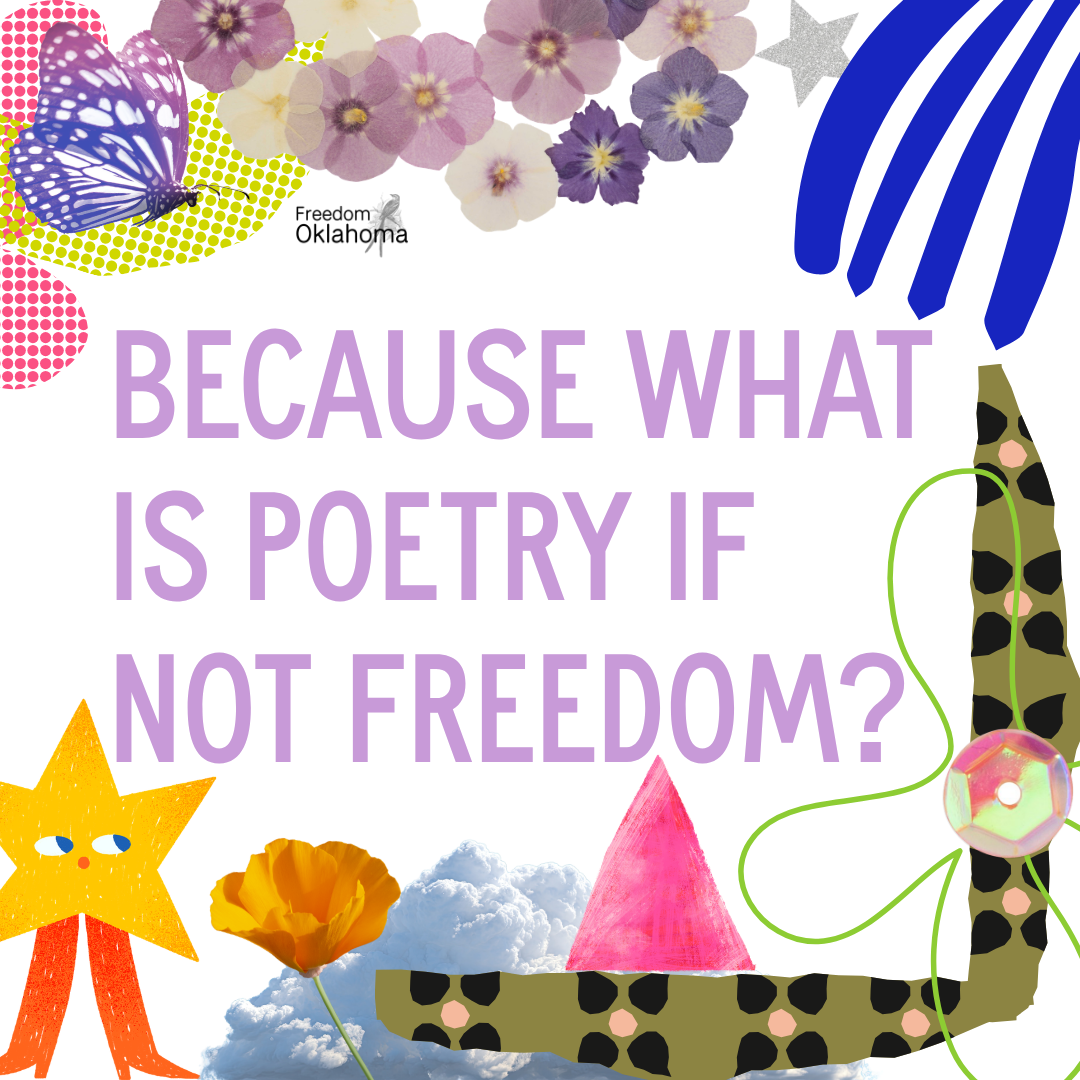
ID: digital collage with floral and doodled elements and text "Because what is poetry if not freedom?"
In her essay Poetry Is Not a Luxury, Audre Lorde begins, “The quality of light by which we scrutinize our lives has direct bearing upon the product which we live, and upon the changes which we hope to bring about through those lives. It is within this light that we form those ideas by which we pursue our magic and make it realized. This is poetry as illumination, for it is through poetry that we give name to those ideas which are - until the poem - nameless and formless, about to be birthed, but already felt. That distillation of experience from which true poetry springs births thought as dream births concept, as feeling births idea, as knowledge births (precedes) understanding.”
I have found myself returning to poetry more and more often in recent years. Both as a reader, an appreciator, and, on occasion, a poet brave enough to share the kernels of truth and hope that I put on a page with others. And I think it’s because at the end of the day, when we so often face the depiction of proximity to power as being power itself, poetry reminds us that power is inherent and it is collective. It’s in the act of sharing that we are powerful, that we can craft new and better worlds.
April 2026 marks the 30th observance of national poetry month. Started by the Academy of American Poets to increase engagement with and appreciation of poetry. I find myself thinking of the Toni Morrison quote, “This is precisely the time when artists go to work—not when everything is fine, but in times of dread. That’s our job!” And so in a time of much dread, much harm, much horror, more than ever we need poetry and poets. Let’s write the freedom futures we need. Let’s read and share them. Because poetry is a necessity, not a luxury. Poetry is freedom. Poetry is power. And poetry is ours.
In Solidarity,
Cole
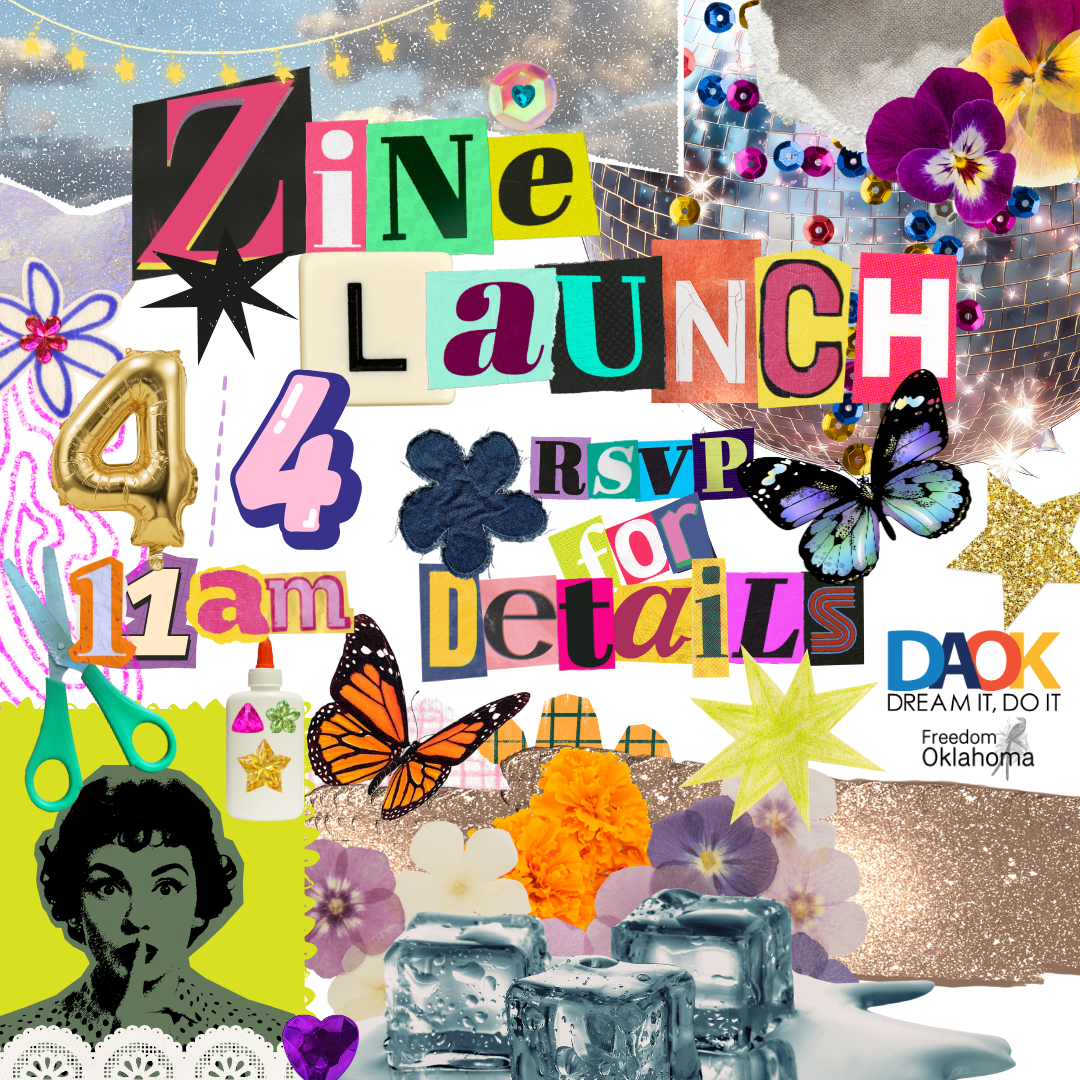
ID: A collaged paper with the words "zine launch 4/4 RSVP for details" surrounded by a mix of patterns and images.
We live in a time where we're all concerned about digital safety and information sharing. And as we embrace how to use digital organizing tools alongside analog ones, we're invited to revisit tools that have long served our communities and reinvest in those skills.
That brings us to zines! Zines (originally fanzines, a portmanteau of fan and magazines) are a non-commercial publication popular across many subcultures meant to share information to a particular community or audience. Often handmade or hand-assembled, zines can be incredible tools for information sharing among our communities, in low-cost offline ways, while still having replication and digital options available.
We've returned to zines a few times over the years, and this Saturday, we're inviting you to our first collaborative zine launch with our friends at Dream Action Oklahoma, with an in person zine assembling event and training in Oklahoma City. RSVP to join us Saturday April 4 at 11 AM for pop up coffee from Latina and Immigrant owned Amour Coffee and Tea, light snacks, zine folding, and content training, all in the joy of shared community. We'd love to see you there. We'll send details about location to folks who RSVP closer to the event date, so make sure you help us get a good head count, and don't miss out on the details.
Register at the link in our linktree or at https://secure.everyaction.com/JaeQcl47xEqBxd6Dybov9A2 to get the details and join us for some hands-on allyship!
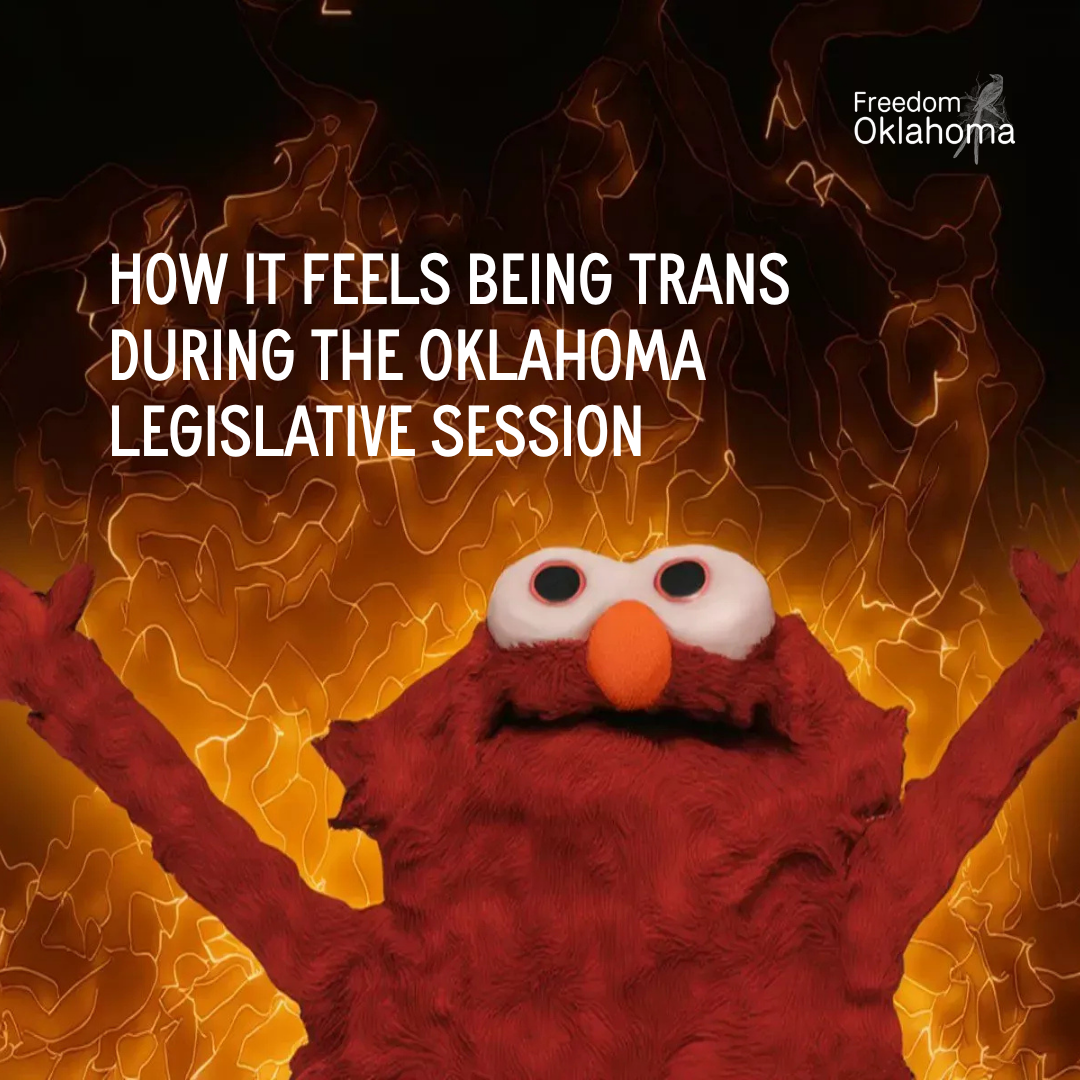
ID: Hellmo (a meme-d version of Elmo with fire behind him) and text "How it feels being trans during the Oklahoma Legislative session".
Our second major deadline of session is over (yay), and with it, we've got our eyes on 29 bills active this session, and 15 more that are carried over from last year and still eligible to advance.
There are a lot of scary proposals moving through this legislative process, but in particular, there are three buckets of policy that pose the greatest threat of harm to our community right now: expanded attacks on health care for trans folks (HB 3130 and SB 904), expanded gender policing for bathroom and housing access (HB 3242), and further attacks on trans+ youth in foster/adoptive care (HB 3586). We tried to break down what each of these bills attempts in their amended versions across social media and in updates to our tracker.
While we have much demand to be vigilant in fighting these ever-evolving and expanding attacks on body sovereignty, we also take a moment to celebrate that a deadline also means saying goodbye to some other threats that will no longer advance this session. They will not be missed.
We've done our best to update bill summaries in our tracker to reflect shucked and amended bills, and will continue to refine that in the coming days. You can find the tracker on our website, on the linktree in our instagram bio, and at https://docs.google.com/spreadsheets/d/1psrNHQD2JDEB9RcQ00PXrph0uIKrjxyZQjnUyEMlfNA/edit?gid=1816847225#gid=1816847225
ID: A collage picture with flowers and patterns and the letters "Love Letters to Trans Oklahomans" with a picture of a type writer in the center of the screen and the Freedom Oklahoma logo in the bottom right corner with a star.
In his book of essays by the same name, Hanif Abdurraqib notes a small paper sign posted over the memorial honoring Michael Brown, a Black 18-year old murdered with impunity by police officer Darren Wilson in Ferguson, Missouri in 2014 that read "They Can't Kill Us Until They Kill Us." And while you should read his whole book and particularly the essay the title comes from, you're also going to get some of my thoughts on how this idea, they can't kill us until they kill us, resonated with this moment in the work.
Because they are killing us. That's true. We know that the policy attacks, the violence in the forms of rhetoric and narrative strategy and hostile infrastructure, the criminalization of existing while trans, it's all part of a genocidal effort that is killing trans folks. Because it's only by physically removing us can they begin to try and eradicate transness, to try and continue to rewrite the collective memory to suggest transness is something novel or the result of indoctrination, and not the reality--that being trans is a natural state, that has been part of our existence to time immemorial, and actually it's the gender binary and the heteropatriarchal gender roles that are the result of indoctrination.
But in the face of every attack they continue to lobby at us, trans folks still exist. Because we've always existed and will always exist. Even on the day despair threatens to overwhelm us, our collective practice of hope means they can't kill transness.
On Trans Day of Visibility, we're reminding ourselves that transness is eternal. They'll continue to attack us, but they can't kill that truth. That's why we fight, why we dream, why we hope, why we build the future where every Two Spirit, transgender, nonbinary, gender non-conforming, genderqueer, genderfluid person has the safety, resources, and community to thrive, everywhere we call home.
Trans lives are worth living. So we live them. And celebrate them. Thank you to everyone who sent love to trans Oklahomans as part of our annual project around Trans Day of Visibility. We’ll continue to compile the submissions in the coming days and add them to our website, so you can visit the collection of love whenever you need it.