
You Care About HIV Decriminalization
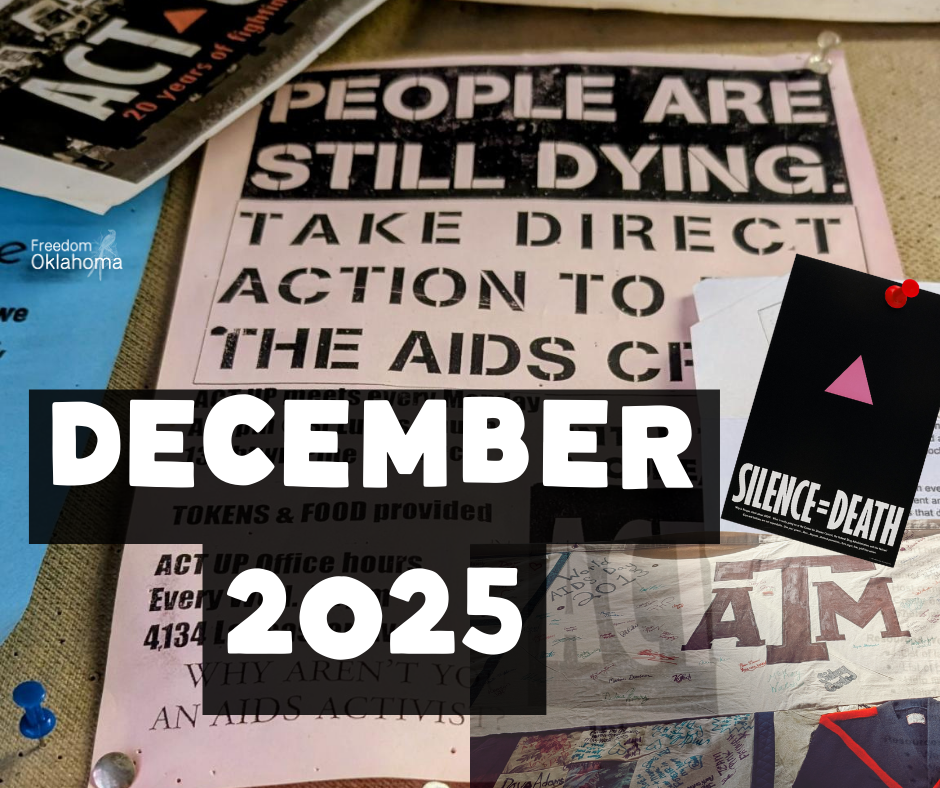
ID: digital collage of various posters and images around World AIDS Day, ACT UP, and advocacy. There is a Freedom Oklahoma Logo and the words "December 2025" in white block font on a black background.
(You Just May Not Know it Yet)
It's December (allegedly), World AIDS Day (even without the federal government acknowledging it as such), and maybe it’s the train ride home and time with family this last weekend, but it makes me think of growing up. I grew up in rural Oklahoma in the ’90s and early 2000s. And while a lot of folks around me didn’t talk about sex, health, or queerness (even when they were living it), I had this unique window into public health because my mom worked at the county health department.
That meant my “normal” childhood activities included overhearing conversations about outbreaks, harm reduction, health struggles, and HIV long before I really had understanding for any of it. But even with those early glimpses, by the time I got to elementary school, Ryan White had already died. What hadn’t died was the government’s willingness to prey on public healthcare fears rather than educate, especially when it came to HIV, AIDS, and the people most affected.
And if there’s anything the last few years taught us, especially watching Oklahoma City shut down the night of the Utah Jazz game in 2020, it’s that public health gets neglected far too easily, while what is unknown gets vilified rather than attempted to be understood. COVID didn’t create that dynamic; it re-exposed it. And it reminded me of how often we repeat the same mistakes we made (and at many levels continue to make) with HIV & AIDS: ignoring experts - especially those with lived experience - withholding resources, and choosing punishment over care.
So, this world AIDS day, I want to talk to you about why HIV criminalization still exists, why it harms all of us, and why you care about this, even if you don’t realize it yet.
Growing Up In the Midwest & Public Health
My mother, who worked at our county health department, opened my eyes to public health (and being nosey) at a very young age - television helped me fill in the gaps. So by the time HIV and AIDS rural outreach was coming to our health department I started learning more about it on TV through programs like And The Band Played On and the Ryan White Story, but also through what I overheard in the local health department break room (miss you girls). So I'll share with you some of the knowledge that I have about Ryan White. One, so that you'll understand a little bit about HIV and AIDS history in America, and two, in hopes to get you closer to the understanding that even in its best intended use, our criminal punishment system causes harm. Because it is just that - a punishment system.
How Federal Policy Helped Create HIV Criminalization
Ryan White’s story sticks with me when I think back on my childhood not just because he was a kid, but because his death, and what came after showed how easily governments can fail entire communities, how resources can be weaponized, and how even in the face of deep compassion, empathy is often only extended to who the broader public deems as worthy of it (i.e. white folks, kids, those portrayed as innocent). That failure takes the form of medical negligence, lack of disability justice or even disability support, punishment-based policy, and ignorance as policy. It's a mirror for how the government still treats people today, especially in states like Oklahoma where rural healthcare is vanishing. In an article Mattew Yin of Oklahoma Watch noted earlier this year “47 rural hospitals in Oklahoma that are at risk of closing, with 23 of them at immediate risk of closing.” Places where folks already have the least access to resources are about to be harder hit by the compounding government choices shutting public health programs across the country. It’s getting worse, as a matter of policy and reality.
When Ryan White was a teenager living in Indiana, he was diagnosed with AIDS, and given six months to live. The transmission in Ryan’s case was the result of a blood transfusion for his hemophilia. That routine medical procedure resulted in intense and immediate discrimination, that he lived with for over 5 years. His fight to attend school, to fight discrimination and stigma, made Ryan the “face of AIDS,” and a driver for HIV/AIDS policy, even though people, disproportionately queer and trans, disproportionately poor, had been dying as a result of government and medical negligence in response to HIV/AIDS for years prior. In the wake of his death, the federal government created the Ryan White Comprehensive AIDS Resources Emergency (CARE) Act - which provides funding to tribal, state, local, and county-level HIV/AIDS healthcare treatment and outreach. Critical dollars that are currently under attack. But lost in the positives of the CARE Act are some of the more nefarious initial requirements, like early provisions demanding the criminalization of people living with HIV. Criminal punishments still on the books, and still used to incarcerate people, to this day. So you got more money to help your neighbors, if you were also committed to locking them up. This fear based policy was meant to be a punishment based deterrent targeting people living with HIV, and even this policy, sold as well intentioned, has only continued the harm of the government’s inadequate, stigmatizing response to HIV.
What does it look like today?
That legacy persists.
Right now, 32 states still criminalize people living with HIV, including Oklahoma, along with tribal governments, including at least 14 of the 39 tribes whose tribal governments and courts operate on land that is also designated as Oklahoma.
Some criminalize people for not disclosing their status.
Some criminalize behaviors that cannot even transmit HIV.
Some criminalize people who don’t know their status.
Some criminalize people living with HIV who engage in sex work.
And all of this criminalization exists despite the scientific fact that people who are undetectable cannot transmit HIV. Despite the fact we live in a timeline where the barriers to folks being undetectable and untransmittable are continuing stigma and lack of adequate, accessible healthcare for all. Despite the fact that public health should be addressed within healthcare spaces, never within the criminal punishment system.
Why This Matters in Oklahoma
Oklahoma has one of the highest incarceration rates in the world, not a flex, and in 2022 the Oklahoma State Department of Health reported that the state ranked in the top 10 nationwide for rural HIV burden. In rural communities, stigma around STI testing, public health, and sexuality runs deep. I grew up hearing more about home remedies than real healthcare. Sex ed was basically “don’t ask, don’t tell,” unless you count the abstinence course taught by the local youth minister, which was… well, it was something. And given that Oklahoma’s attempt to update HIV/AIDS curriculum for the first time since 1987 resulted in a veto by Gov Kevin Stitt in 2019, none of the bare minimum we have comes close to health justice or parity with regard to HIV.
So when folks don’t get good information, don’t have access to affirming healthcare providers, and don’t have normalized conversations about testing, prevention, or treatment, we see preventable conditions become exacerbated harms. And then we are punished for the outcomes of systems designed to fail us.
Why I Fought for HIV Decriminalization
When I found myself elected to the Oklahoma Legislature, I carried all of this with me - the rural upbringing, the health department breakroom, Ryan White, the COVID deja vu. I got the chance to write some of Oklahoma’s first HIV decriminalization legislation — and some of the nation’s first retroactive decriminalization policy. As someone that is HIV possible, that matters to me.
Because our criminal punishment system, even when it claims good intentions, is not built for care. It is built for punishment. And punishment is not healthcare. Punishment is not prevention. Punishment is not justice. We need not only to disrupt the criminalization (which is still being actively used to incarcerate people based on their HIV status), we need to begin to repair the harm to those who have been criminalized under these laws. That is something I think we should all be invested in.
The Truth: Everyone Has an HIV Status
And knowing your status is a form of love - to yourself, your partners, and your community.
We’ve made incredible advancements:
DoxyPrEP, taken after potential exposure to reduce bacterial STIs
Free, at-home test kits in Oklahoma that come in discreet packaging and connect you with next steps
And yet, stigma keeps folks from accessing these tools.
I didn’t get my first HIV test until I was 31, this was after I wrote that legislations. I didn’t start PrEP until I was 32. If you’re reading this and thinking, “Damn, that’s wild” or “I should have gotten tested” that’s okay. That’s human. And you deserve care without shame and you’ve still got time.
What I Want For You, And For Us
I want us to live in a world where we get to laugh longer, kiss longer, dance longer, rest longer, and show up for each other longer. Knowing your status helps us do that together. Fighting HIV criminalization helps us do that. Taking care of each other, especially when no one is looking, helps us do that.
You do care about HIV testing, funding, and decriminalization - even if you didn’t have the language for it until now. Because when we say our liberation is bound together, this is exactly what we mean.
Love you all,
M. Turner | Director of Digital Organizing + Communications | They/Them
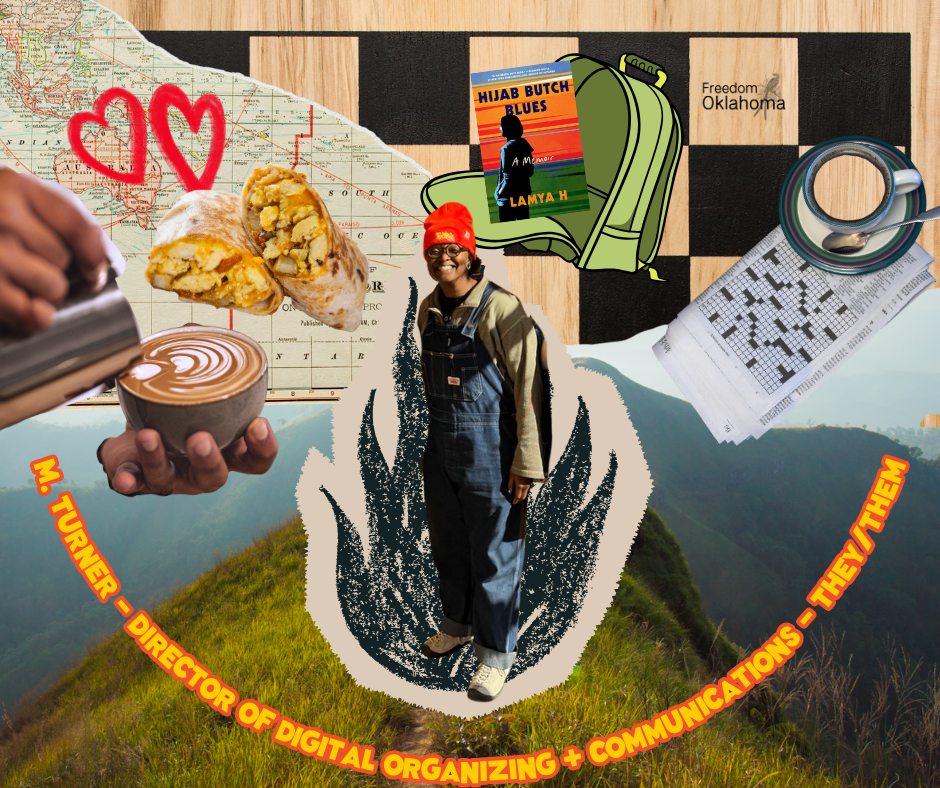
ID: On a collage of scrap paper, there is a cutout of M on a collage of scrapbook-like cutouts of coffee, tea, a chessboard, breakfast burritos, and backpack with the book Hijab Butch Blues, a ripped map, and trail on a mountain. Under it says M. Turner - director of digital organizing and communications.November Programming With Freedom Oklahoma
FOK Office Winter Break
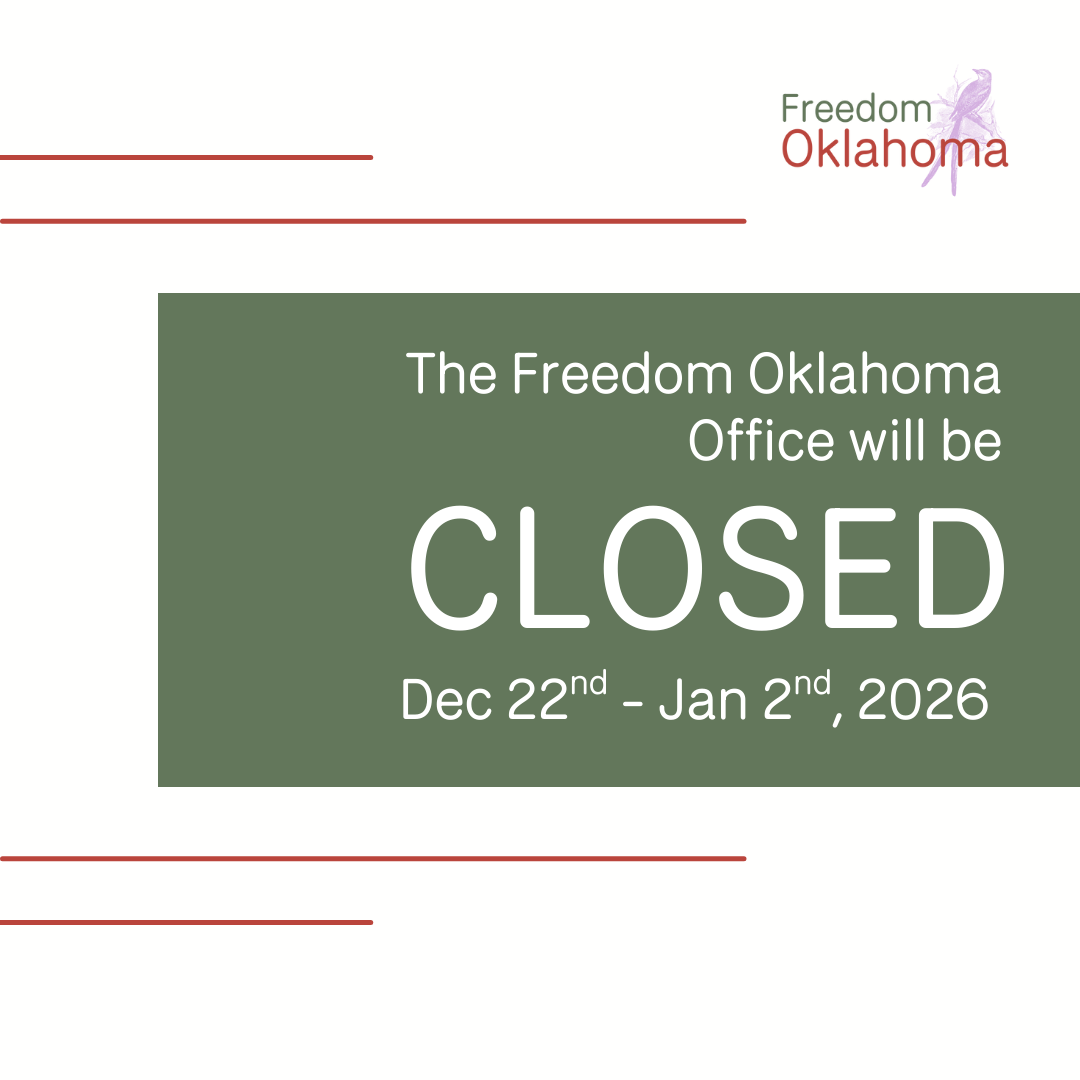
This work is deeply personal to all of our staff, and we believe that in order to best serve our broader community, we have to honor ourselves in this work with rest when we can.
To prepare for the work that 2026 will bring, our office will be closed for the final two weeks of 2025. If you have the capacity to grant other people (or yourself) room to rest, we hope you'll take the opportunity to do just that.
Community Groups!
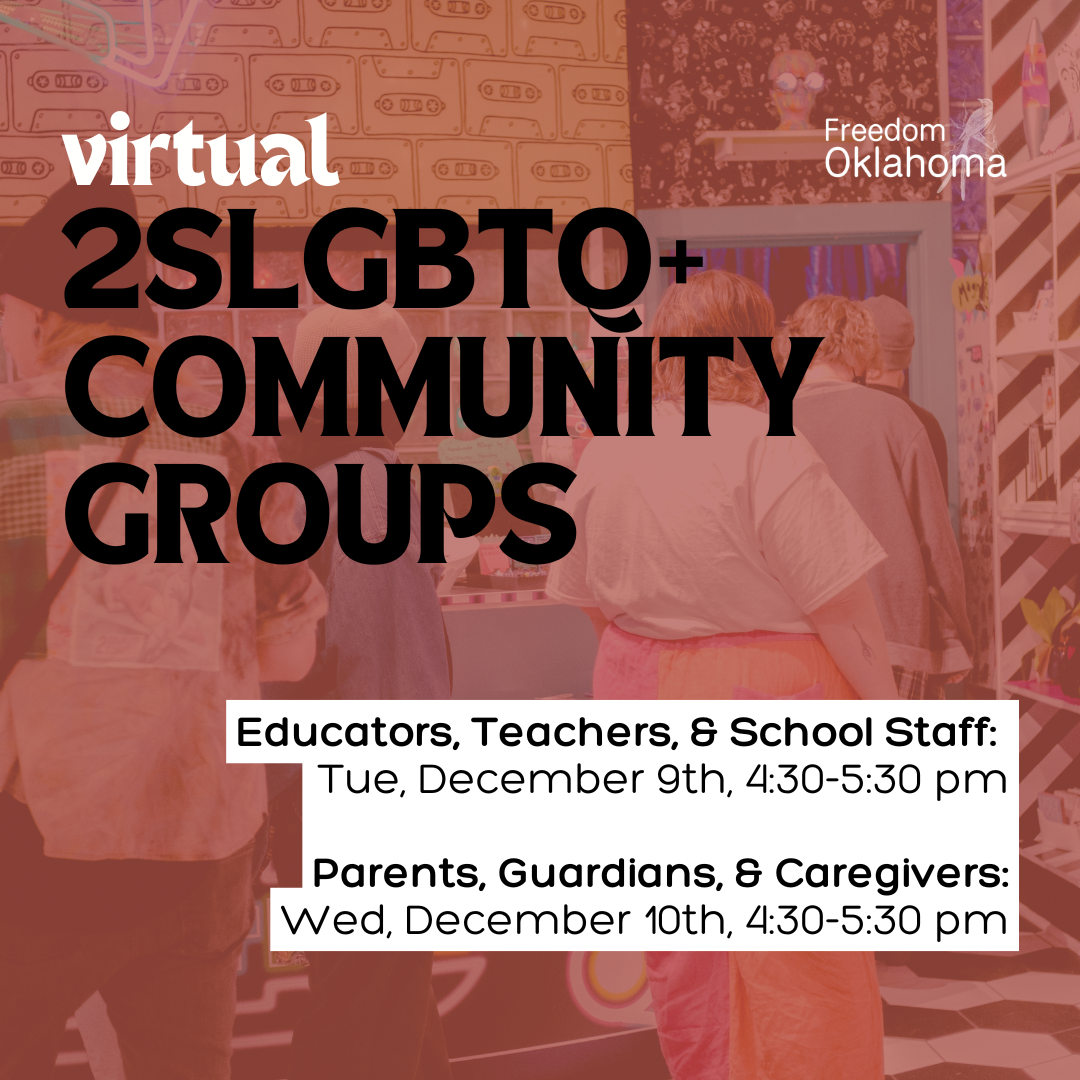
Join us for our December Community Groups! We'll be chatting about upcoming community events and how we can best support you as we wrap up 2025.
Schedule:
Educators, Teachers, & School Staff: Tue, December 9th, 4:30 - 5:30 pm
Parents, Guardians, & Caregivers: Wed, December 10th, 4:30 - 5:30 pm

December Pen Pal Group
Special message from kitty: WRITE MORE!
Join our Beyond Borders Pen Pal Program to connect with queer youth across the U.S.
December Youth Group
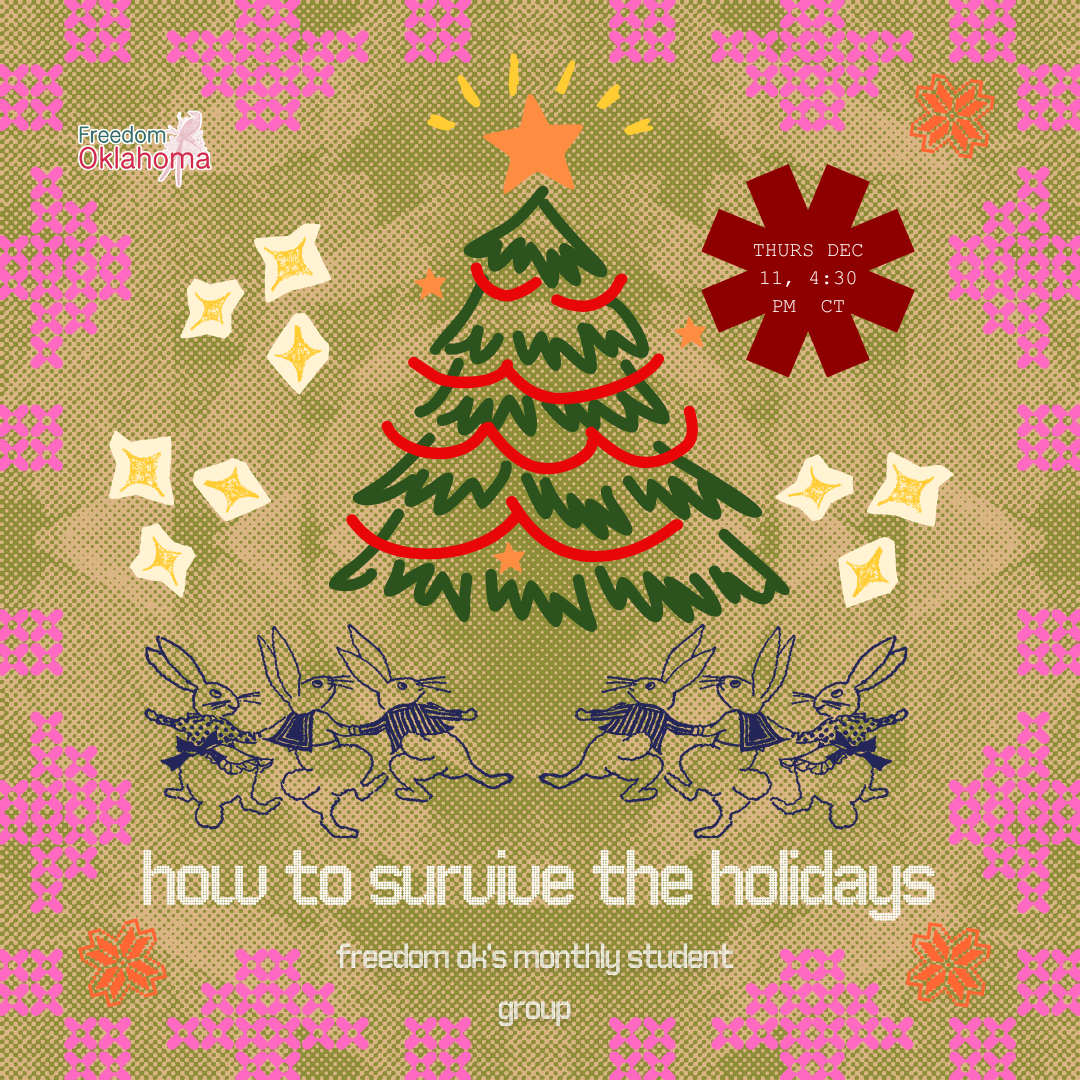
This month we will be talking through what we need to make it through the winter/holiday season. Creating a plan can make it easier to make it through until we can get back to our chosen families, and the disruption of our routines can also help us learn new coping skills. We will have time to talk through anything you're going through as well as anything you want to celebrate. We look forward to seeing you there!