
The Freedom to Dream: Mapping Freedom Futures
ID: digital collage with map and travel elements and a Freedom Oklahoma logo. Text “february monthly update and freedomoklahoma.org/news” with a Freedom Oklahoma logo.
Every February marks the start of a new legislative session. And as I inevitably make my way back into the ever-more oppressive Capitol, I think of the paths I have charted to arrive back here. Because at the end of the day, while we have charted abolition geographies within various spaces in the Capitol, it is never a place that feels like freedom.
Abolition geographies is a term coined by scholar and visionary Ruth Wilson Gilmore, to describe the ways in which we can visualize and build abolition by thinking about the spaces in which abolition exists, the spaces we build. Rather than focusing on the what we do without (what we’re abolishing), thinking about the spaces in which we build and make that abolition real.
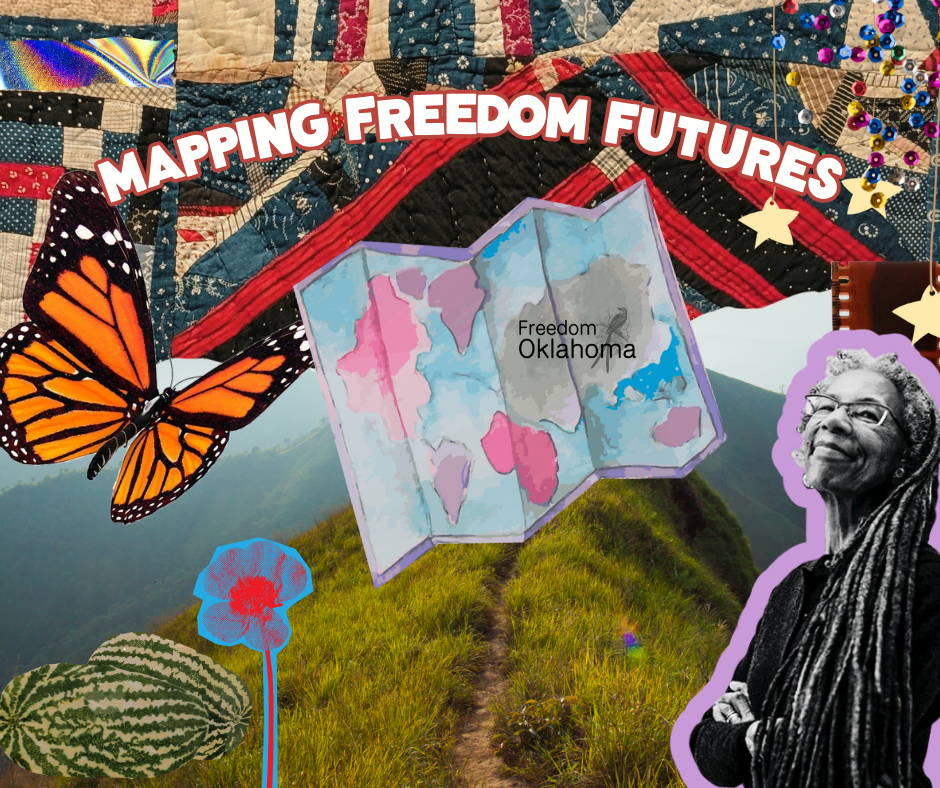
ID: Digital collage featuring a photo of Ruth Wilson Gilmore, a map, a butterfly, watermelon lithographs by Ruth Asawa, a cyanotype flower, a log-cabin pattern quilt and text “Mapping Freedom Futures” with a Freedom Oklahoma logo.
“In other words, one need not be a nationalist, nor imagine self-determination to be fixed in modern definitions of states and sovereignty, to conclude that, at the end of the day, freedom is a place. How do we find the place of freedom? More precisely, how do we make such a place over and over again?” - Ruth Wilson Gilmore, Abolition Geographies
And as I’ve reflected on abolition geographies, I’ve thought a lot about how we chart the path to these spaces, how we recognize them, bring others along to the spaces that are freedom, and grow that abolition topography. Not as in a colonizing abolition, but as in an uncovering, a re-Indigenizing, re-abolitionizing our spaces to build the future where we all have the freedom to thrive.
And maybe that all feels a little heady, but I think that ultimately, 2STGNC+ folks understand abolition geographies, in that we have built abolition geographies in our bodies and our minds, in our chosen families, often in our households where people come and go as they need.
While Freedom, Oklahoma quite literally exists on a map (much to the confusion on occasion to the folks tagging us on social media thinking we’re the town and not the 2SLGBTQ+ liberatory org), as we mark 11 years as an organization, I think about where we’re carving out the abolition geography Freedom Oklahoma really means in our work.
And I’ll note, it starts with acknowledging we’re in a tough place. Funding for 2SLGBTQ+ work has continued to dwindle, and 2STGNC+ led and centered orgs like ours continue to disproportionately feel that impact. It has left us with a smaller staff, of now 2 full time team members and 2 interns carrying the work. And it has also forced us to reimagine expectations and capacity, as we reflect on what we do that is business as usual and what our community actually needs to get us closer to freedom.
So bare with us as we chart this new path together. As we figure out the funding gaps, and make space to craft abolition geographies rooted in our shared capacity, values, and needs.
You’ll hear a lot more about this in the coming months as we reimagine our work in more liberatory ways. And, I wanted to leave you with some guideposts that I’ve crafted in this moment for what’s now and what’s next.
We work from a disability justice lens, from an abolitionist, Indigenous, queer politic, rooted in the Black radical tradition as Cedric Robinson defines it, “a collection of cultural, intellectual, action-oriented labor aimed at disrupting social, political, economic, and cultural norms originating in anti-colonial and antislavery efforts.” As an organization founded from intra-system advocacy, we work to free ourselves from the constraints of respectability politics, rooted in white supremacy, and return to the radical roots of our movement engaging in values-based praxis, following the leadership of those who have long paved the way for change in our community–rooting our work in information sharing aimed at informing community, power building, and art-based activism.
We know that liberation is a community effort that takes place across identities and movement spaces. We are working to ensure that Freedom Oklahoma will always be a 2STQ+ centered organization, committed to doing work in a way that never compromises on behalf of those most historically marginalized and excluded, including Two Spirit folks, trans folks, queer folks, Black folks, Indigenous folks, disabled folks, poor folks, folks whose existence and/or survival has been criminalized, people living with HIV, people who use drugs, folks who engage in sex work and other pleasure and/or survival economies, folks without access to fixed housing, folks without documented immigration or citizenship status, folks who have been or are currently incarcerated, and others who have had the systems of the status quo try to treat their dignity and autonomy as anything other than inherent.
As we do this work, we’re working in an expanding surveillance state, where our people and our work face increased threats of criminalization and targeting by the state, its actors, and vigilantes acting based on rhetoric and propaganda that suggests the fight for liberation should be feared. But we’re not going to sit in that fear. Because for generations 2STQ+ folks have made spaces of freedom in the midst of great struggle and hardship and threat (and reality) of violence. We’re carrying on the work of generations. Mapping a future rooted in ancestral knowledge. We’re making freedom geographies real, starting right here in this place we call home. And we’re grateful that we get to do it with you.
In Solidarity,

Cole McAfee, Freedom Oklahoma Executive Director
they/she
Freedom February Updates:
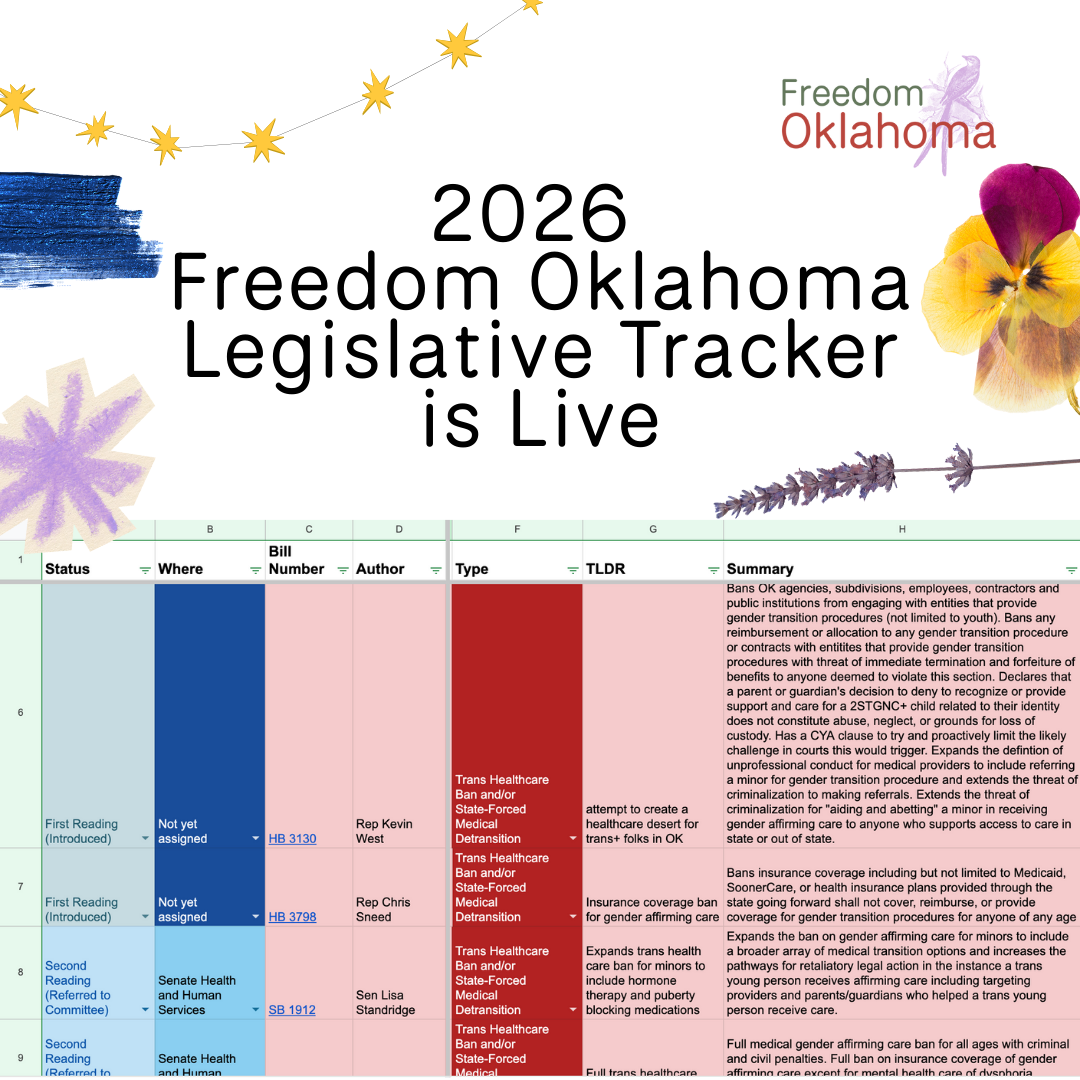
ID: digital collage with a screenshot of the 2026 Freedom Oklahoma legislative tracker and text “2026 Freedom Oklahoma Legislative Tracker is Live”
It’s that time of year again. The Legislative Session has officially begun, and to try and make the process a little less obtuse, we’ve yet again compiled a legislative tracker to share the bills that we’re following along with this session. Because it is an even numbered year, you’ll find the bills from the 2025 session that have carried over, along with the newly introduced bills that caught our attention. Our ED (and keeper of the tracker) Cole will talk through trends and bills of note on Instagram live this Wednesday February 4 at noon on our Freedom Oklahoma Instagram, with the full video available on our page afterwards. And you can see our tracker any time at https://zurl.co/U6sDI or at the link in our instagram bio.
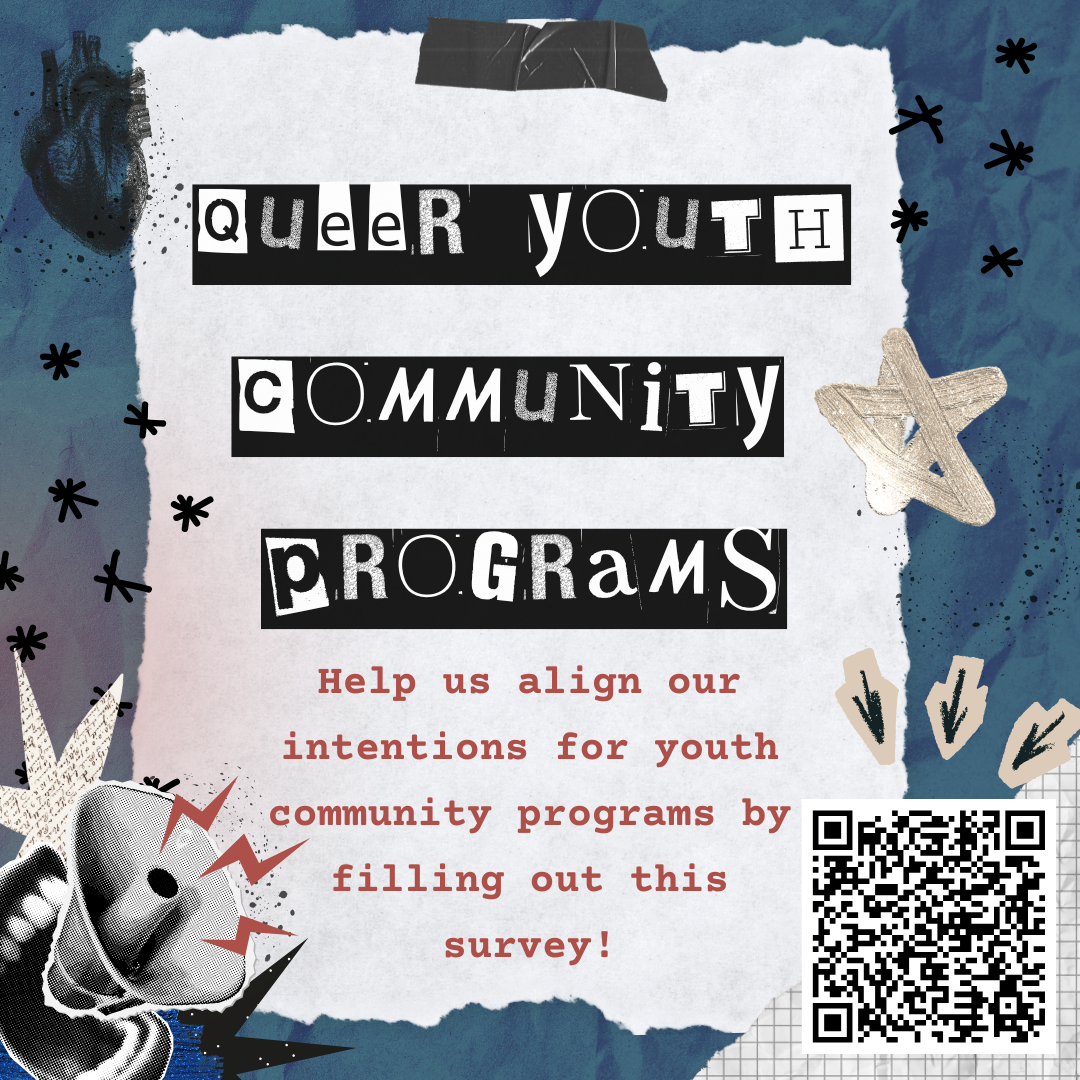
ID: Blue crumpled flyer with black ink speckles, paper and glitter stars, mouths, and megaphones. Text reads “Queer youth community group." and "Help us align our intentions for youth community group by filling out this survey!"
Are you a part of the 2SLGBTQ+ youth community (ages 13-24)? We want to hear from you! Help us out by completing our survey so we can grow our youth community group sessions.
We want to find what more we can do in our work to empower 2SLGBTQ+ youth. How can we contribute to facilitating queer joy? What gaps in services are there for 2SLGBTQ+ Oklahoma youth that we can all help fill? What would you like to see for queer people living here? Let us know!
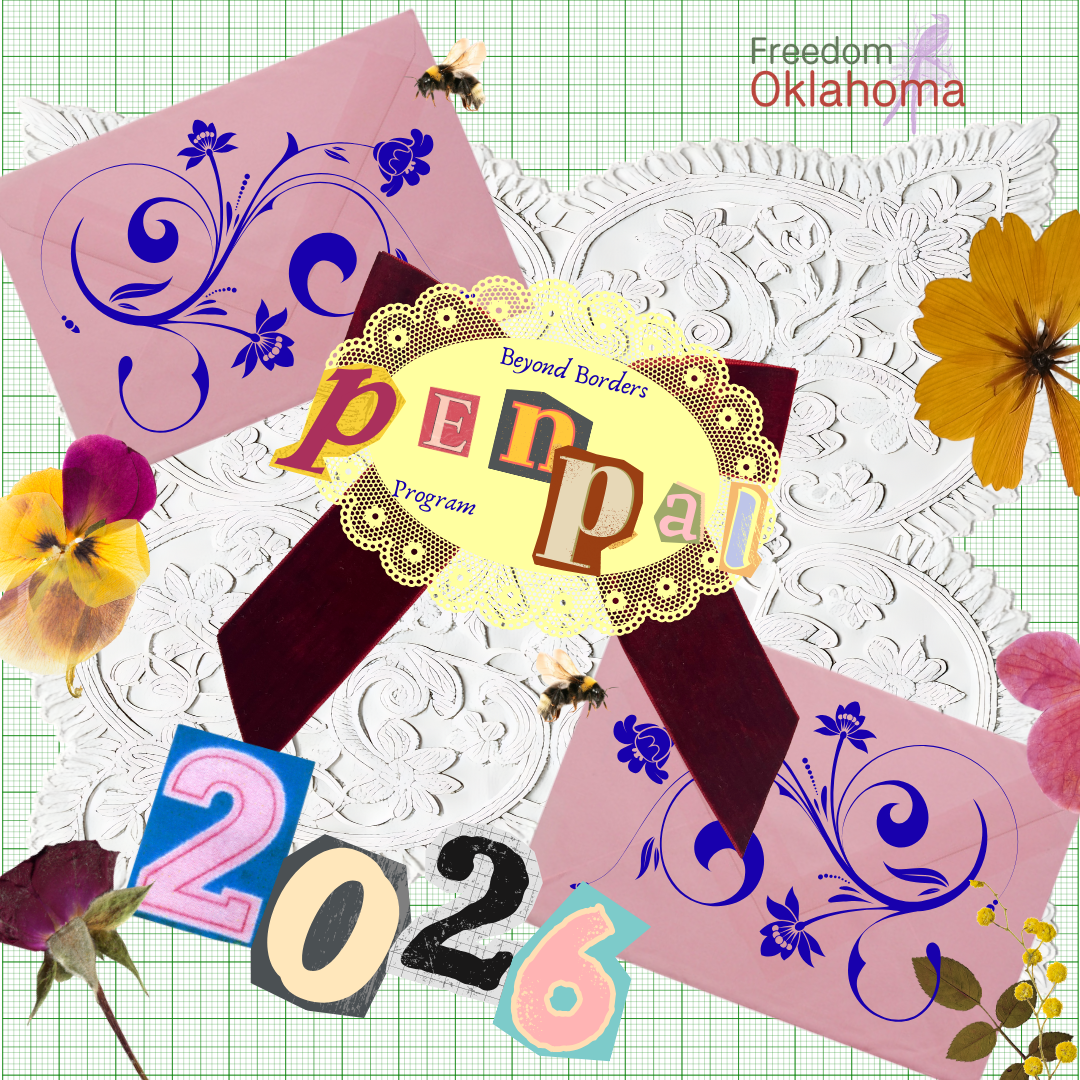
ID: Pink envelopes, white and yellow doilies, pressed flowers, and bees. 2026 is presented in cut-out numerical. The Beyond Borders Pen Pal logo sits on a red velvet bow. The Freedom Oklahoma logo is in the top right corner.
Create art, a poem, or just write an old-fashioned letter to send to other 2SLGBTQIA+ youth in the state and beyond!
Freedom Oklahoma’s Beyond Borders Pen Pal Program (ages 13-17 and 18-24) is all about sharing queer joy, while making connections with other 2SLGBTQIA+ youth.
Register at https://zurl.co/4KuJB or with the link in our IG bio 🌟🎊