
solidarity (as praxis) forever
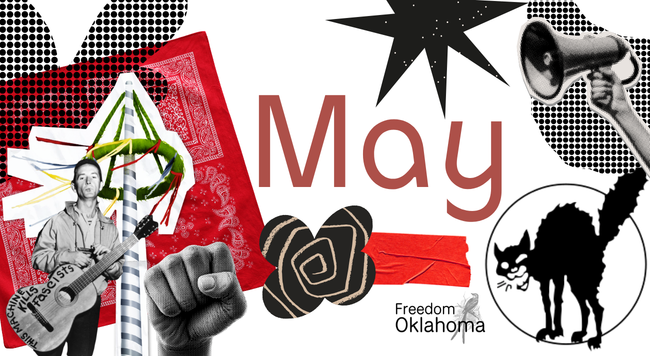
ID: digital collage with imagery including a maypole, a picture of Woody Guthrie and his guitar, and the IWW black cat, Sabo Tabby, along with text “May” and a Freedom Oklahoma logo.
Comrades,
The song Solidarity Forever was written in 1915 for the Industrial Workers of the World a movement dedicated to class solidarity across labor and among all the working class, whose revolutionary politics have made it the target of much government targeting, propaganda, and malignment, including from other union entities who fear it is too radical, too decentralized, too welcoming to the most marginalized and transient to organize with. And you probably wouldn’t know that if your familiarity with the song is in present day centralized union organizing spaces, labor day events, or from more sanitized versions of Oklahoma history that don’t want to get into the politics of Oklahoma’s own Woody Guthrie (our very own antifa singer songwriter). It’s why knowing the context and the history of something that becomes a symbol, beyond the collective memory around it, can be so important. It’s solidarity not as an idea, but as praxis that we’re honoring this May Day (International Workers Day), in the radical roots of Mother’s Day, and beyond.
First things first, praxis is absolutely one of those clunky academic words. And it’s one that I think has some heft to it when we talk about the importance of doing the work. So what does it mean?
praxis /prăk′sĭs/ ● noun
Practical application or exercise of a branch of learning. Established practice; custom; habit. Use; practice; especially, exercise or discipline for a specific purpose or object.
Synonyms: use, practice
Ultimately, praxis is how we’re taking what we know and what we’re learning, and applying it to build the kind of future we deserve. Through a present where solidarity is actionable, a constant commitment to one another and our collective liberation.
This is not the first time I’ve called on us collectively to commit to making solidarity real. But I think it’s something we need to recommit to urgently, regularly, and earnestly. Because there’s a long history of solidarity we’re building on. And while some of that history gets glossed over, whitewashed, or sanitized, it’s in doing the work of care, of learning, of learning from our ancestors and building for future ancestors that we better understand the revolutionary, radical shoulders we stand on.
So for me, here is an incomplete list of concrete ways I’m engaging in solidarity as praxis. And I invite you to make a list, and revisit it often, to ensure you’re meaningfully, actively working in solidarity, too.
Regularly visiting the BDS list, to understand how I can better engage in active strategic boycotts.
Donating to local investigative outlets, journalists, and movement and investigative journalism infrastructure for marginalized and excluded folks, to help ensure that critical reporting happens in the places where it’s least funded and supported.
Starting a tool library with friends, so we can all practice asking for help and reduce consumption.
Checking out books from my local library. And making requests my library purchase new releases by 2SLGBTQ+ authors. And working through challenges on storygraph to intentionally diversify my reading list and expand the perspectives, learning, and stories I’m engaging with.
Sharing ideas about solidarity practices with my community, then refining my practices based on that feedback (like our solidarity sessions framework).
Learning and practicing analog art forms, especially those dismissed and undervalued because the artists are historically disproportionately women and femmes. Right now, that looks like taking a hand sewing course with Martha at Oklahoma Contemporary, signing up for a bookbinding class at Trove, practicing collaging and creating a personal archive through my junk journaling (with encouragement from OKCreative Club), and keeping an eye on opportunities to expand my knowledge and practice at acidlime, through free classes at Second Story Books, and through programing at my library, just to name a few.
Sharing physical space with friends.
Masking as earnestly and as often as I can (because solidarity with immunocompromised and disabled folks is almost always something we can all do better and is particularly important as and for trans disabled community).
Making zines!
How are you actively engaging in solidarity? Where can you expand that practice? How are you talking about solidarity as praxis with the folks you’re in community with?
There are so many ways to approach solidarity, whatever your interest, capacity, or entry point. So let’s make solidarity a commitment, a verb, a praxis, as we approach all that May sends our way.
In Constant and Committed Solidarity,
Cole
There’s something about the act of creating together that transcends time. Maybe it came from the idea that many hands make light work, but even as our need to produce crafts has become less a necessity, we find ourselves coming back to collaborative spaces to make and learn and share in the art of crafting together. It’s one of the many reasons we find a long tradition of organizing among craft spaces. From more formally organized abolition quilting bees to the act of gathering to bead and connect folks to resources or to share oral histories through song while dying wool, the intersection of craft and organizing seems to have existed since time immemorial.
For us, there’s novelty in moving back into those spaces, with intention, to engage a broader audience in our work. Sharing space while sharing skills, opens people up to listening and connecting. And that becomes the foundation for our Craft and Care project. We believe that in hosting collaborative craft and care spaces with different movement partners and in different mediums, we can foster spaces to share our work with new audiences.
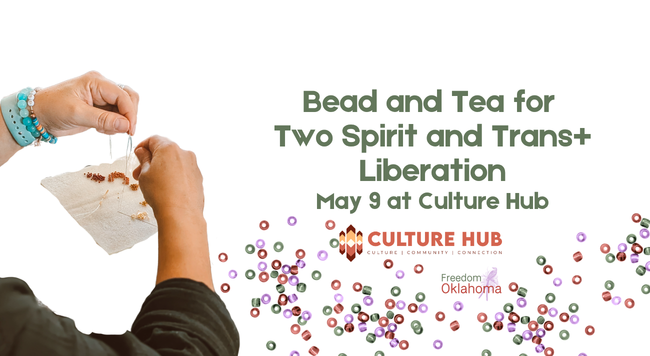
Join us for our first space in collaboration with Culture Hub on May 9 at the Culture Hub community center in OKC, for beading, tea and light bites, and the chance to talk about how we shift the narrative on 2STGNC+ liberation right here on this land we call home.
This event is free, and space is limited, so RSVP today!
Last month, we joined movement journalist, storyteller, and truth-seeker,Deon Osborne, on his podcastIn Depth With Deon,produced by Pod 4 Good, to talk about the work of Freedom Oklahoma. Tune in to hear us talk HIV modernization, the cross-liberatory nature of 2SLGBTQ+ work as we approach it at Freedom Oklahoma, personal journeys, and how we practice hope.
Watch the video here!

If you've ever had your rights, liberty, and/or safety determined by the Oklahoma Legislature, you might be familiar with the term Sine Die. By COB the last Friday in May, the Oklahoma Legislature is required to adjourn sine die, ending the regular session. While we've faced all sorts of special sessions and other disruptions to any peace Sine Die might bring over the years, it at least marks an end to some of the harm.
As we approach May, this year we're doing so with a budget plan crafted and agreed upon by the minority party. That combined with the fact it's an election year means the legislature could declare it a wrap on legislative session even earlier than the last Friday in May. Whenever it's over, May means the end of legislative session, and all of the shenanigans (like bill shucking), late-night agendas, and general chaos that comes with it.
This session we're seeing a number of harmful policy priorities targeting our community continue to advance. As always, you can follow along with everything we're watching this session here. And keep an eye out for a virtual legislative debrief led by Cole, following shortly after whenever the legislature calls it quits for this session.